9.12.11

Seychelles


Can, Yucel and I headed off to the Seychelles in August. And since we are now in December all depressed by the short days and cold weather I thought it would be perfect timing to bring out turquise waters of the ocean.
Yippee!
Now even though it was a short holiday with a long haul flight, travelling with a baby has its limitations. Frankly speaking it also requires alot of preparation and strategy building regarding the necessary equipment, food, diapers, disposable bibs etc etc... I read somewhere (though it is an exagaration) that travelling with a baby required more preparation that an army waging out to war.
Ours was pretty cool though. The champagne cooler made a perfect strelizer for baby bottles :)

 
In search of the route that William and Katherine took we headed to Victoria where via a catamaran we reached the Silhouette Island/ Labriz Resort and Spa (Hilton) with a journey that took roughly 2 hrs. The waters is pretty rocky as a side note.
Some travel notes:
  • Here is the link to the resort :http://www1.hilton.com/en_US/hi/hotel/SEZLBHI-Hilton-Seychelles-Labriz-Resort-Spa/index.do
  • The capital of Victoria is home to a very pretty restaurant called `Marie Antoinette` cooking the regional food.
  • Seychelles is great for all water related activities from shark diving, snorkelling to fishing.
  • Silhouette Island renowned as a nature park is also great for daily hikes.


Marie Antoinette Restaurant

7.12.11

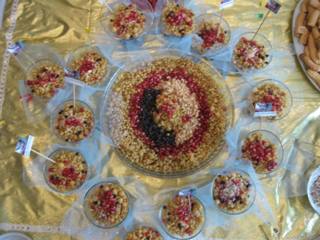
"Dişbugdayi" / First teeth celebration

This is one of the Turkish traditions for the baby. Where the families celebrate and welcome his first teeth.
We welcomed Can's first teeth this November and along with it came a family celebration over a Sunday tea-time table.
For the table setting let your imagination go wild. Cookies, cakes, quiches, pies the sky is the limit.
But there is one element that must prevail along with a tradition to back it.

The cooking of wheat.This is where the name "disbugdayı" derives from (teeth+wheat). Its supposed to create abundance and blessing for the baby.

Cook 400 gr wheat, bring to boil and set it aside to rest for a day.
On the morning of the celebration add 1 glass of icing sugar, a handfull of chickpeas, peeled pomengranates, almonds, hazelnuts, dried apricots, dried raisins, dried cranberries to the wheat and decorate with colourful bonbons, Turkish delights, dried fruit. ( whatever takes your fancy really...)


Before you serve put in one or two coins or beads as a surprise. Whoever finds these on their plate is supposed to buy gifts for the baby:)


At the end of the day: one big happy smile :)

Neckwarmers !

Finally, its December. I don't know why but apart from April and September, this month is one of my favourites in the annual calendar.
Maybe because it marks new beginnings or hope, or maybe its just the twinkling lights scattered everywhere in the city that lifts my spirits up.
Its also a great time to share gifts with your loved ones and cuddle up as much as possible with a hot cocoa.

Neckwarmers are a great gift to prepare and share on these chilly days.
Here is one of my favourites! (Ps: I am lucky as my mother-in-law has been kind enough to prepare one just for me!)
,

15.9.11

Canan Tolon and Elvan Alpay

Turkish comtemporary art is growing exponentially. I have become particularly fond of the works of two artists namely Canan Tolon and Elvan Alpay thanks to my cousin Selen who's been working with them at GaleriNev. Their work is amazing and in my opinion they are sight for sore eyes both graphically and  emotionally.
Canan Tolon's inspiration is the industrial and architectural backdrop of San Francisco streets and buildings. Where as Elvan Alpay's work is spurt of flower power from the canvas.

Canan Tolon exhibition is due to start on 17th September at GaleriNev, Istanbul.
Here's a couple of their pieces.
Enjoy,
xxx
Elvan Alpay, Galerinev

Elvan Alpay, GaleriNev

Canan Tolon, GaleriNev

Canan Tolon, GaleriNev

18.5.11

Inspiration: Gaziantep's Kutnu cloths

Kutnu is a kind of cloth locally produced in Gaziantep region and Anatolia. Kutnu actually derives from "cotton" but today the cloth is produced with silk, cotton or a combination of both.
The designs of kutnu reminded me of the style of Turkish designers such as Rifat Ozbek and Atil Kutoglu. I do wonder if it was a source of inspiration for them?